E-commerce Development

Storefronts built to sell, not just to launch.

11 capabilities 04 answers

Everything that happens after the add-to-cart button

A store is not a website with a basket bolted on. The catalogue has to be structured before it is designed, the checkout has to survive a customer with a poor connection and one hand free, and someone has to decide what happens when a courier loses a parcel. Those decisions shape the build far more than the homepage does.

We build on the platform that suits the catalogue rather than the one we like best, connect it to the systems that already run your business, and hand it over with a team that knows how to work it. What you get is a shop your own people can run, not one that needs us every time a price changes.

Built around the catalogue, the checkout and what happens next

Platform

Shopify

A woman working at a laptop in a bright open-plan office, an e-commerce orders dashboard open on screen.

For most catalogues Shopify is the sensible answer: hosting, payments, security and app ecosystem handled, so the budget goes into the storefront and the merchandising rather than into plumbing. We build custom themes rather than reskinning a bought one, which is what keeps the store fast and the checkout unbroken.

Platform

WooCommerce

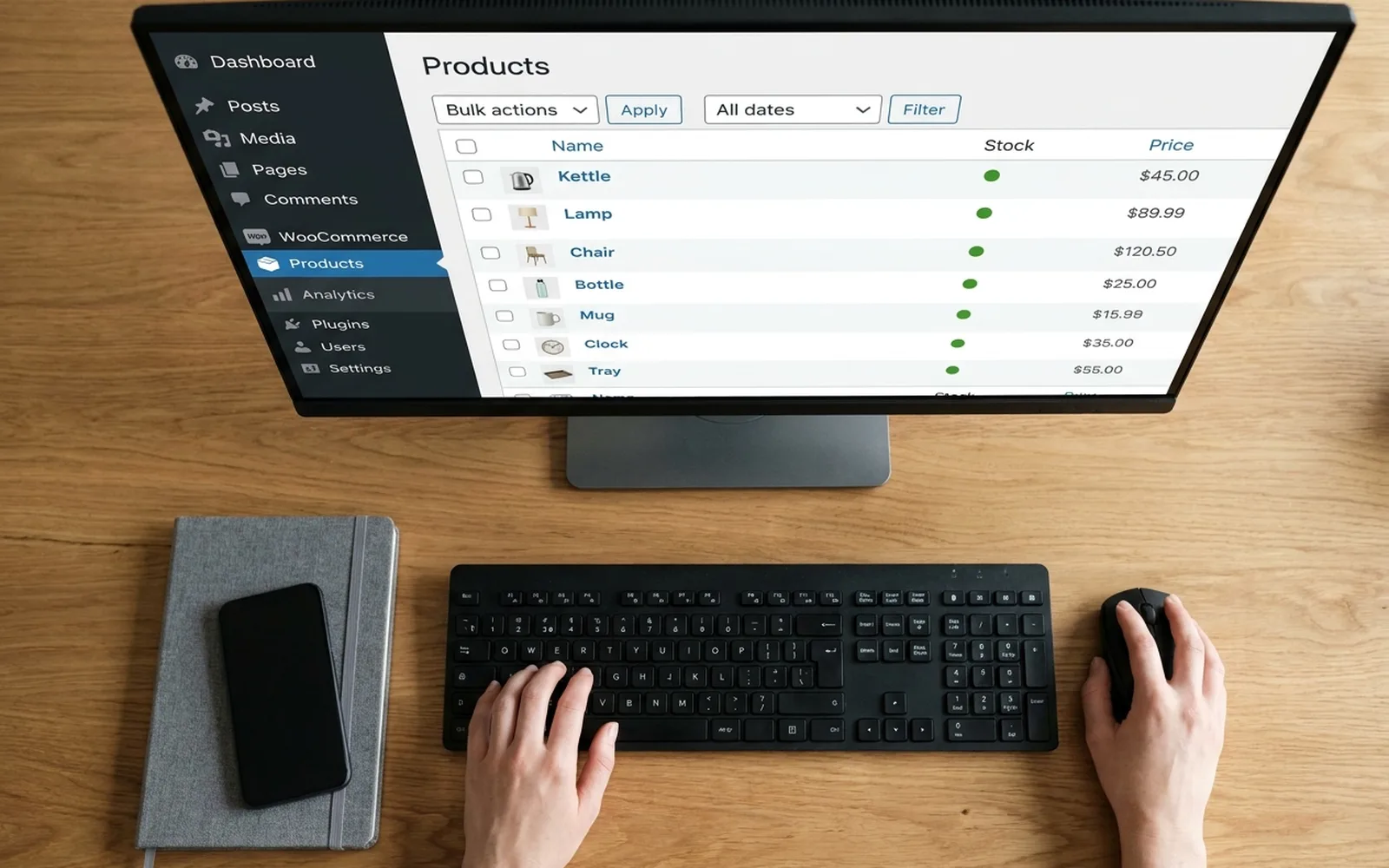
Overhead view of a person working at a desktop computer showing a WooCommerce product list in the WordPress admin.

When the store lives inside a bigger WordPress site, or when the rules around pricing and products are unusual enough that a hosted platform fights you, WooCommerce gives you the control back. It also gives you the maintenance obligations, and we are upfront about that trade before you pick it.

Platform

Custom Storefronts

A person working at a desktop computer beside a window, viewing an online store page with a grid of eight products showing names and prices.

Some catalogues do not fit a platform. Configurable products, B2B pricing tiers, quote-to-order flows or a stock system that has to stay where it is. A headless build costs more and is worth it when the alternative is fighting a platform for the next three years.

The shop

Catalogue and Product Data

Boxed electronics accessories arranged on a white surface beside a camera on a copy stand and a laptop displaying the photographed product images.

The least glamorous part of an e-commerce project and the one that decides whether anyone finds anything. Categories, variants, attributes, filters and the naming that makes search work. Get it wrong and no amount of design rescues it.

The shop

Checkout and Payments

A person holding a phone showing a checkout screen with an order total, holding a plain grey chip payment card in the other hand.

Every extra field loses customers. We keep the checkout short, support the payment methods people in your market actually use, and test the whole thing on a mid-range phone rather than a desktop, because that is where most of it happens.

The shop

Conversion and Speed

A laptop on a desk displaying a store performance dashboard with a conversion funnel and site speed scores.

A store that loads slowly is a store that is closed. Image handling, script discipline and Core Web Vitals are part of the build, and once it is live we test the parts that decide whether a browse becomes a basket.

Connected

Integrations

Two colleagues in a high-rise meeting room reviewing a systems architecture diagram on a wall-mounted display.

Stock, orders, invoicing, shipping and support usually already live somewhere. Connecting the store to them is what stops your team retyping orders into a second system, which is the thing that quietly eats the margin.

Connected

Marketplaces

A warehouse operative in a hi-vis vest checking a product listing grid on a tablet in a racked fulfilment aisle.

Amazon, Flipkart and the rest reach people who will never visit your site. Listings and stock kept in step with your own store, so you are not selling the same last unit twice.

After launch

Support and Iteration

Three people wearing headsets working at desktop computers showing customer support ticket queues, with two colleagues talking behind them.

Trading businesses change weekly. Sales, new lines, seasonal pages and the fixes that follow a platform update. We keep the store maintained rather than handing over a zip file and wishing you luck.

Runs alongside

E-commerce SEO

A woman at a desktop computer viewing a Google Shopping results page filled with product listings.

Getting product pages into organic results is its own programme and sits with the SEO team.

See our SEO services
Runs alongside

Website Design

An overhead view of printed page layouts, a colour fan and a type specimen sheet on a white desk, with a tablet showing the same layout.

If what you need is a site rather than a shop, that work has its own page.

See our website design

Frequently Asked Questions

Shopify or WooCommerce?

Shopify unless there is a reason not to. It costs a monthly fee and saves you most of the maintenance. WooCommerce makes sense when the store is part of a larger WordPress site or when your pricing and product rules are unusual enough that a hosted platform gets in the way. We will tell you which one your catalogue actually needs.

Can you move an existing store without losing rankings?

Yes, and the redirect map is the part that matters. Every existing product and category URL is mapped to its new home before launch rather than after, because a migration that loses organic traffic has cost you more than it saved.

Will my team be able to update the store ourselves?

That is the point. Products, prices, pages and campaigns should not need a developer. We hand over with a walkthrough and documentation, and stay available for the things that genuinely need code.

Do you handle the product photography and copy?

We can. Catalogue photography and product copy are their own workload, and they are usually what delays a launch when a client plans to do them in-house alongside a day job. Worth deciding early which side is doing it.

Let’s Work Together.

contact@reddashmedia.com Contact us
Get a Quote